A LETTER FROM THE MARGINS.
On the price of being heard, of the story in the glosses, and the love beneath the rage.

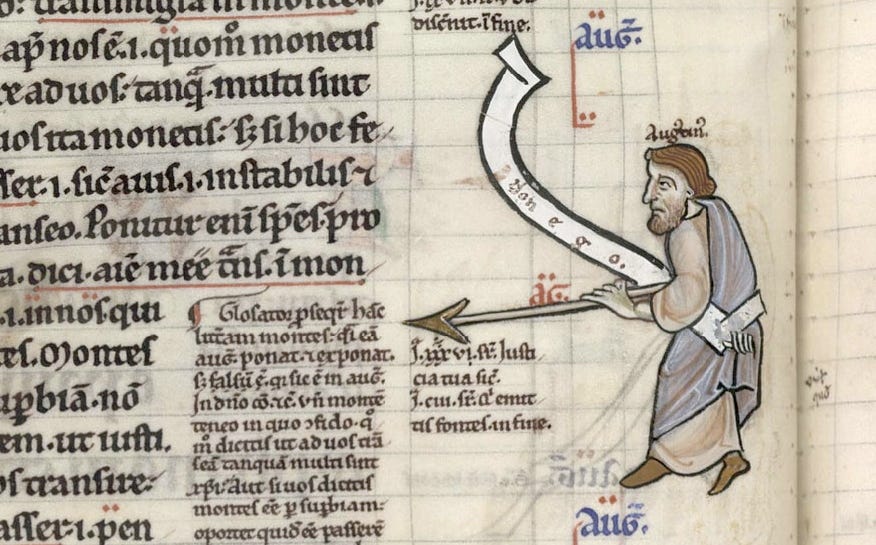
I was eleven years old the first time I understood that my answer to an ordinary question was a provocation. It was a simple question, the kind every kid gets asked at school: “Where are you from?” The other boys answered it the way you produce a coin from your pocket to buy sweets. “London.” “Brighton.” “Norwich.” “King’s Lynn.” For each of them, the coin was examined, accepted, and the line moved on.
“Palestine” stopped the room.
The Master said,
“I’m sorry? Palestine? That’s not a place.”
I remember my heartbeat in my ears. The smell of floor wax and the clicking of the radiator. The dust curling through the air, backlit by the tall windows. Most of all, I remember the silence. The other boys going still in the way boys do when the next thing is unpredictable.
Nobody laughed. It would have been easier if somebody had. The Master simply moved on, not giving me a chance to offer another answer. He was matter-of-fact. He was not angry, and in that absence of heat were the coordinates of the lesson. He was not bothered, because nothing I was saying was worth the effort; I was simply mistaken about where I was from, the way a boy can be mistaken about the capital of Peru.
I have spent the rest of my life inside that moment. So has every Palestinian alive.
My real education was the understanding that I would be permitted to speak of being Palestinian on one condition: I had to prove it first. Prove the provenance. Prove the lineage. Prove the dates. Prove the year. Prove the deed, the key, the census, the grief.
Other men inherit a country. We inherit a case file. We are expected to carry it into every room and open it on request, with a fluency that makes many mistake the performance for our truth. Do it well, and you will be called what I was called: reasonable. I have come to understand the curse of that compliment. Reasonable, for a Palestinian, is a license to exist and speak. It is a license that can be revoked, and the men who issue the licenses will never grant you one you can keep.
Understand, I am nobody. I want to be exact about this, because exactness is the only vanity I have left. I am, if we are being precise, exactly fucking nobody. I am one man with a keyboard and a groaning bookshelf, commanding exactly no army, moving exactly no markets, and existing in a world that has organized itself so efficiently around my nobody-ness that my irrelevance requires citations and a notarization for the simplest claim.
I cannot even write
the smallest true sentence I own,
“I am Palestinian,”
without a stranger arriving to dispute it,
to explain to me that the noun is an invention,
that the identity is an unfounded rumor,
that I am a rounding error holding a flag.
And it is not my politics that are being audited. It is my existence. And when your existence is under audit, you learn the auditor’s language so young that you can forget, for thirty or forty years, or fifty years, that you have never agreed to the audit at all.
Deny the Holocaust on LinkedIn, under your own name and photograph. Your career will be over by dinner, which, to be clear, is as it should be, because that is what a civilization looks like once it has decided a people’s catastrophe is beyond dispute.
Now write that there is no such thing as a Palestinian, that the people are an invention, and the Nakba a lie. Nothing will happen to you. A few Palestinians might chime in. But from others? A yawn, maybe. You might catch a few likes from people with flags in their bios. A sitting cabinet minister said it at a podium in Paris and flew home to his portfolio with no consequence.
The first denial ends a career because the dead it insults are guarded by the entire weight of the acceptable page, and the second one costs nothing, and it has never cost anything, and I long since stopped expecting it to.
‘The West’ here is a lazy phrase, and I am not in a lazy mood, so let me be precise about who carries the auditor’s clipboard. The editor, friendly, progressive, genuinely fond of you, who wants one more pass to make the piece a little less angry. The politician who marches for every justice on the map and goes quiet at this one, because his donors are watching. The kind soul at a dinner party who needs to hear you condemn Hamas before passing the salt, the loyalty oath as amuse-bouche. The broadcaster who says clashes while one of the parties has an air force and the other builds rockets out of irrigation pipe.
Not one of them would recognize the word auditor in the mirror, and yet every one of them freely wields the auditor’s red pen.
Edward Said gave this condition its name
more than forty years ago.
He called it “permission to narrate,”
and observed that the Palestinian request for permission
was the one application that stays forever pending,
reviewed by a clerk who is never at the desk.
Said has been dead for over twenty years, and the request for permission to narrate is still listed as Received and Pending. And through it all, we stand in the queue, waiting; Palestinians with their case files and their best manners, who understand that the line itself is the institution, that standing in it is the tax, and that no one collecting the tax has any intention of approving the application.
I know what it would look like to walk away from that queue in dignified silence, and I am declining that too, because silence is the queue’s preferred product. And I can hear the objection forming. I have trained for decades to hear the objections before they are spoken: “Here he is again, polished, fluent, performing for the West in its own tongue, some exit. Not much of a refusal.”
The objection is half right, and owning the half is the point. I am writing this in the auditor’s language, with the auditor’s grammar, deliberately, because the clerk’s ink is the only ink this office has ever recognized. But I am also choosing to burn the paper of the application and use it to burn down the office. A form burns just as well in official ink. This essay is the application, taken back off the desk and set alight in front of the window. What you are reading is the smell.
There is, in the moral imagination of the West, The Scripture, and The Commentary. The Gospel and The Gloss.
The Scripture, the Gospel, is Jewish pain, and before I say one syllable more, I will say what must be said and say it whole: Jewish pain is real, it is vast, it is among the deepest wounds in the human record, and the people who carry it watched the world subtract six million of them within living memory and they owe nobody an apology for vigilance. I have sat close enough to that grief to feel its heat. I would not increase its weight by a milligram, least of all by handing its bearers the weight of mine.
I mean every word of that paragraph. I will defend every word of it. But it is also true that I was not free to leave out a single one of those words because they are a required tariff. That paragraph is the tax, paid in the middle of the essay as the price of even discussing the existence of the tax.
No Jewish writer is required
to spend a paragraph honoring Palestinian suffering
before being permitted to mourn the Holocaust;
no editor would request it;
no reader would feel its absence.
An absence in mine is an instant invitation
to the ‘What about Hamas?’
and ‘How dare you minimize’ questions,
and it would have been noticed
before the title was finished.
Even in an essay against the audit, the auditor gets his payment anyway, sincere and compulsory in the same breath. I cannot even name the arrangement without bowing to it first. The bow was real. But so is the requirement.
Palestinian pain is allowed on the Western page in one form only, as the Commentary. It can only exist as The Gloss, the small type at the bottom, in the margins, in the apparatus, the places where a page keeps its housekeeping. Yes, the catastrophe, comma, but. We are only ever the but. We are only ever the asterisk on another people’s testament, named only so that the naming can be pointed to and forgotten on the way back to the Gospel.
When you grow up in the small print of the marginalia, you learn quickly the typography of your own erasure. You learn it so thoroughly that you can typeset it yourself, placing the type in the frame by hand in the dark.
And for most of my life, that has been the entirety of the only deal available to the Palestinian narrative: be legible, be brief, and stay in the margins. Stick to the bottom of the page, or be absent from it. And nobody reads the footnotes.
The library’s shelves are filled with volumes of Scripture. Full of the settled and sealed and selected version of the Gospel, done up with handsome gold-lettered spines, endpaper maps, the smell of glue and old paper, and the confident weight of the accepted truths. You can take one down, almost any one, and run your thumb through the index and find my family’s entire universe filed under See also.
I am done at the bottom of the page.
That is the whole of my message. Everything else is detail. Here is some of that detail.
Seventy-eight years is the distance between my grandmother’s door in Jerusalem and this keyboard half the world away, and people call that distance history so that they can file it. A wound becomes history only when the last person who can feel it has died, and we Palestinians have declined, so far, to complete the paperwork. The recent dead of my family lie severed from the soil their ancestors slept in for centuries. None of this is ancient, and none of it is a metaphor, and I will not be producing the documents, because the demand for proof is shaped exactly like the boot I am describing, and a man does not refute the boot by polishing it.
And what is happening now, in the strip of coast the world has agreed to discuss in the passive voice, is exactly what it looks like.
An entire place has been unmade.
Buildings have come down by the tens of thousands,
the children have been counted,
and there are people, grown-up salaried people,
who respond to the counts by disputing the counts
and who presume to audit the graveyard
and call the audit rigor.
There are precise and serious and legal words for what a state does when it turns its whole machinery upon one people. Words drafted by careful men and women in the dull, quiet rooms of post-war Europe, with elements and definitions and case law, precisely so that catastrophe could be measured by somebody other than its victims. Curses get shouted. These accusations are notarized and filed. Occupation. Collective punishment. Persecution. Apartheid. Genocide.
The careful people have done their measuring, including Israelis whose love of their own country no honest person disputes, and the measurements came back, and I am not going to stand in front of the instrument panel pretending that where the needles point is a matter of opinion.
Neither will I pretend the scale is even. One party to what the newspapers call a conflict possesses an air force, a navy, an intelligence service that can find a single phone in any city on earth, an arsenal it does not trouble itself to confirm, and the signed blank check of the most powerful nation in the history of nations. The other party has no state, no army, no airport, no harbor, no currency, and no door out.
Both bleed. Denying the blood is an obscenity. I have never denied the blood, and I never will; a child is a child is a child, and grief admits no exchange rate, and the small body at the kibbutz weighs precisely what the small body in the rubble weighs, which is everything.
Grief is symmetrical.
Power is not.
Even the word conflict, draped over a man strapped to a chair, stops describing anything and becomes a curtain. And printing both names in the same size type on the scoreboard is the oldest trick of the people who own the press.
Here I owe you a distinction, because I have asked you to hold distinctions all the way through this letter, and I will not exempt myself from the hardest one. Zionism is a word that holds multitudes, and I have known many of them. For millions of Jews, it has meant something I think of as tender. It is the bed that cannot be taken away, the door that locks from the inside, it is the conviction, purchased at a price no people should ever have paid, that there must be one place on earth where Jewish children sleep without packing.
I do not quarrel with that longing. I recognize it. It rhymes with my own longing, only with the names changed, and the day my people’s version of the same thing stops being treated as a security threat will be a good day for everyone alive.
But inside the same word lives another project that has outgrown the fringe. It holds portfolios in the cabinet and General Officer commissions in the military. Once a year, it marches through the Muslim Quarter of Jerusalem, chanting and threatening death to me and to people who look like me. It burns villages at night and then heads to the hilltops for dinner, drafts legal opinions for hilltop extremists, and invents euphemisms and neologisms for the ministries: voluntary emigration, relocation, encouragement. A whole thesaurus employed to keep the words expulsion, ethnic cleansing, and genocide off the page. At its center sit men and women in good suits and unaccented English, explaining that between the river and the sea, one people is destined to rule and the other is to be managed, thinned, and eventually missed by no one.
It is a project of ethnic, religious, and racial supremacy. It has cousins on every continent and a long family album, and the unbearable and unjustifiable suffering in its bearers’ pasts does not change what it is, because suffering has never yet vaccinated anyone against becoming what they survived.
I say this with all the care I own.
Most of the Jews in my life—and my life is blessedly full of them, in my heart and at my table and in my work—want no part of that project, and some fight it as hard as I do, paying steep costs I have watched them pay with pride.
But it is not a handful of cranks either, and the polite fiction that it is, the insistence on reading every torched olive grove as an aberration and every village pogrom as the work of a few bad hilltops, is one more way the page protects itself. A movement is responsible for what it tolerates in its name. So is a country. And so, while we are here, am I responsible for what is done in mine, which is why my own side’s men of blood appear in this letter too.
I am asking only
that the suits and the podiums
stop working as camouflage,
and that the thing inside the respectability
be called what we would call it
anywhere else on earth.
What happened on the seventh of October was a horror. I say so because it is true, and truth is the only tribute I will pay anywhere in these lines. The people murdered in their homes and in the fields that morning were human beings entire, and their deaths sit inside me beside my own dead without canceling a single one of them, because a soul is not a ledger and I refuse to keep books in mine.
My own side holds men I am ashamed of, men who rule decades past any mandate, men whose prisons have swallowed their own critics, men who spend the lives they swore to protect like meaningless coins, without even keeping the receipts. I name them in the same voice, for the same reason, and I will name them exactly once, because the theater in which the Palestinian denounces Palestinians to reassure the audience is the one show of ours that never closes, and I have no interest in the soliloquy.
None of what that morning unleashed, and none of what produced it, is sui generis. Violence of that order is a crop. It has soil, it has weather, it has had seventy-eight years of patient irrigation, and the question about the soil excuses nothing. It happens, however, to be the only question that has ever prevented a second harvest, anywhere, in the whole bloody record of our species, and the people who forbid the question are not protecting the dead. They are fertilizing the field.
I have been speaking from a height for some pages now, and the truth does not live at a height. A borrowed hall on a weeknight. Folding chairs in uneven rows, an urn of coffee nobody finishes, name tags peeling off sweaters. Jews and Palestinians, the bereaved and the merely exhausted, the kind of gathering that draws no coverage because nothing burns. A woman from Nablus and a man from Tel Aviv are saying things to each other that their governments would call treason. The room is filled with the wrung-out tenderness that follows shared testimony. And then a phone hums. Someone jumps in with news. An attack in Israel. Israeli civilians dead.
This letter is worth nothing if I only confess on schedule. The truth is that as the news settled over the room, something in me went cold and did arithmetic. Something in me, quiet as a sentry, hissed in the dark: Maybe now they will know how it feels. What it costs.
I wish I could tell you it lasted half a second. That it was an intrusive thought quickly dismissed. That would be a convenient but untrue tale.
No. It stayed. It sat with me through the announcements and the hurried goodbyes, through the stacking of the chairs, and the worst part, the part that is hard to say out loud, is how it felt. It felt like warmth. Like an understanding hand on the shoulder. The voice of an old and treasured teacher telling me that I was finally being honest with myself, and I carried it out into the night air and into the car, and it kept me company the whole way home, steady, articulate, patient, making its case from the files it had been keeping since I was a child.
The fever broke a little past midnight, on no argument at all. Across that room, earlier, I had watched a man I admire, a man who has placed his own body and its privilege of religion and passport between settlers and Palestinian olive trees, cry as he heard the news from Israel. And somewhere past midnight, his face came back to me, unasked, the way faces do, and the arithmetic finally could not hold against it.
I am not telling you this to be absolved, and I am not performing a wound for you either. I just want you to understand that what I have written here about soil and harvests, I know from the inside. The crop grows in me too. It grows in us all. Watered by the same seventy-eight years, and the difference between the men I condemn and me is only that I am able to put the thought down before morning, while they have built a politics out of keeping it alive.
There are nights when that difference feels thinner than I want it to be. The disease is ecumenical. It does not check your paperwork at the door. The vigilance I insist on in others in these pages is the vigilance I demand of myself first, at the only checkpoint I have ever agreed to stand at, the one on the inside.
There are two fears that enter the room whenever any of this is said aloud, and I will speak to both, plainly, with the hope that plainness will deliver the truth more cleanly.
There are people murdering Jews in my lifetime, this year, in capitals and suburbs that thought themselves past it. Antisemitism is not a debating point. It is a fact, ancient, adaptive, climbing, and Palestinian agony is neither its cause nor a currency in which it may be paid.
I do some of my work shoulder to shoulder with Jews, with Israelis, with the bereaved of both houses who have somehow declined to hate each other, and each of us is called traitor in our own tongue for it. Those rooms, I will tell you, are the only rooms I have ever entered where nobody asks where I am from with an argument already loaded in the pocket.
And the mirror of that hatred is also real and runs at a discount: the boy stabbed for his name outside Chicago, the worshippers shot in their mosque, Death to Arabs sung in stadiums and down boulevards on two continents. A man who can see only the bigotry aimed at one tribe has not taken a position against bigotry. He has joined a team and issued his conscience a jersey. I am not on a team. I am against the thing.
The second fear is newer and quieter. I have watched it move through rooms full of people I love, so I will name it gently and exactly.
For the first time since the war that gave the Gospel its standing, the Jewish story is not the only center of the Western page on the region. It held that center for eighty years the way a body holds the middle of its own bed, and when the center is the only seat you have ever been offered, the arrival of company can feel, from inside, like eviction.
Nobody is being evicted. There are two different sentences in play here: your pain does not matter is one, and your pain is not the only pain that organizes the page is the other. Only the second is being said.
Equity can land like loss on anyone who begins from primacy; that is gravity, and I hold the feeling of vertigo against no one.
But check the instruments before you trust them.
The floor is level.
It only feels tilted from where you were standing.
And the privilege I am naming here is one privilege, narrow, specific, nameable: the privilege of narrative, the default sympathy of the page, the old unexamined custom by which your dead arrive with names and faces and anniversaries while ours arrive as an estimate, a range, a figure in dispute before the bodies cool. Losing that will feel like falling for a while. It is landing. Your pain matters this morning exactly as it mattered yesterday, and it mattered immensely yesterday. What is ending is the monopoly, and the monopoly was never the thing keeping you safe. Centrality did not stop a single pogrom. It only stopped you from seeing us.
Which brings me to the cost of the arrangement that nobody itemizes, the line on the invoice that’s addressed to you.
A page built so that one grief is scripture and another is housekeeping does not merely starve the small print. It blinds the congregation. It manufactures, year upon year, edition upon edition, the most addictive product in the moral economy, which is innocence. Innocence kept past the age of knowledge stops being a condition and becomes a decision, and decisions have owners.
No one is born guilty of any of this.
No one is born guilty of anything.
But somewhere in these seventy-eight years,
the not-knowing has ripened into a choosing,
and the choosing has grown comfortable,
and the comfort is never free.
The weapons are bought with your money and mine, the cover is signed in our names, the plumbing of it runs straight through every house on the street, and a comfort that requires somebody’s children to remain a rounding error is a transaction, whatever else it is dressed as. I have no use for your shame. I am here to turn on the lights, which is a different act, and the difference is measurable: look what it costs me to do it, and look how little it would cost you to look.
People ask me where I stand on applying pressure, questions about boycotts, divestment, and sanctions that usually arrive as a litmus test. Here is where I stand: the machinery I described some pages ago, the jets and the checks and the vetoes, runs on money, and some of the money is mine, and a man who has noticed his own hand in the plumbing does not get to be precious about pressure. I boycott the engines of it, I divest from them, and I support sanctioning them. The settlement goods, the arms pipeline, the institutions of the occupation itself and those that gain advantage from them are all fair game. I will not perform anguish over inconvenienced industries while children are being killed.
My only critique of the pressures is that there is a version of the movement that has built a permissions desk of its own. It boycotts the bereaved mother for the company she keeps at the grave. It blacklisted the one film two peoples made together about a village being erased. It calls the people in my borrowed hall normalizers, which is a polite word for traitors. I have stood at one desk my whole life, and I am not going to bow at a second one because this clerk pronounces my name correctly. Pressure aimed at power, always. I differ only on where we should apply the standards and to whom, and I will always protect the kinds of rooms where people practice the future.
I will not be deferring any of this to a more convenient evidentiary standard. The proof exists; the careful people have it; my own version of it sits in a drawer I have been filling my whole adult life. The drawer is closed, not because the case is weak, but because I know that the courtroom itself is part of the injury.
A man’s testimony of his own life is not a thesis to be sent back for revisions. I have received the revisions for forty years. Soften it. Contextualize it. Open with the other side’s story. I decline the notes. Palestinians are not asking for permission anymore. We will narrate our own stories, and we insist on a place that is on the page, and not in the margins.
And now a confession withheld for the end, because at the beginning you would not have believed it. All of this is love. It will not have sounded like love, because you have been taught that love sounds like agreement. It does not. Ask anyone who has ever been loved by someone brave. I love this maddening, luminous double helix of peoples, the arguers, the mourners, the grandmothers on both sides of the wire who stuff the same eggplant and scold in the same cadences and bury their dead below the same sky. Rage that has been held this long, examined this closely, and has still refused to curdle into hatred, is what love sounds like after seventy-eight years in the waiting room. If I did not love you, I would not wake you.
Something in the binding of the book has given. The leather has cracked with the particular sound that a book makes the first time it is opened properly, and a new generation has opened the page and is holding the book up to the light, reading the small print in the margins out loud, in public, and declining to put it back. Nobody is burning the book. The demand was only ever for a better edition. The Gloss is moving into the text, and the Gospel loses nothing by the company; it has never needed the margin to be holy, it only thought it did, and that thought was the whole catastrophe, and that thought is ending.
If you ask me, as people always ask, which map I am for—one state, two states, confederation, some federation of cantons not yet drawn—I will tell you the truth that disqualifies me more often than not: I do not care. The map is furniture. I have watched grown men fight over the floor plan of a burning house while the fire extinguishers sit close to hand unused. What I want fits in a single sentence and requires no cartographer: every person between the river and the sea, free, safe, equal, and answerable to the same law, with the same law answerable to them, regardless of name, blood, faith, or flag.
Whatever architecture delivers that, I will support, and gladly. Whatever architecture withholds it, I will refuse, and I do not need to see the blueprints first, because the only part of a house that ever tells the truth is the door.
In the end, I am not the annotation on anyone’s story. I never was. None of us were or are or should be. Two peoples stand on one land, and neither of them is leaving, and I have never, for a single hour of my life, wanted yours gone. The page, even now, even this late, is wide enough for both scriptures, set in one size of type, and what gets printed next is, for the first time in my life, genuinely undecided.
I experience every one of your sentences, both individually and in the aggregate, as a gift. In addition to the ones you highlighted, I could add many more that moved me to tears from feelings I have trouble naming. Being present to truth/veritas/emet does that to/for me.
Still, I pull and highlight these sentences and paragraph as the truthiest truth of all:
"All of this is love. It will not have sounded like love, because you have been taught that love sounds like agreement. It does not. Ask anyone who has ever been loved by someone brave. I love this maddening, luminous double helix of peoples, the arguers, the mourners, the grandmothers on both sides of the wire who stuff the same eggplant and scold in the same cadences and bury their dead below the same sky. Rage that has been held this long, examined this closely, and has still refused to curdle into hatred, is what love sounds like after seventy-eight years in the waiting room. If I did not love you, I would not wake you."
And I, a Jew of a particular age living in a devastatingly complex time, receive your love--and offer you mine. Never stop writing the wake-up calls, Mo.
You write like the brother I never had and didn't even know I wished for until I read your words today. And I know families fight, challenge and contend with one another, so I expect not to agree with all that you say. Yet, such love resonates in your prose, even withal there is pain and anger there as well. As a Jew, daughter of survivors, I know you acknowledge my generational anguish. I wish all my contemporaries, Jews everywhere (if that's not too much to ask) could acknowledge yours, too. May we all live in peace and equality from the river to the sea.