THOUGHTS

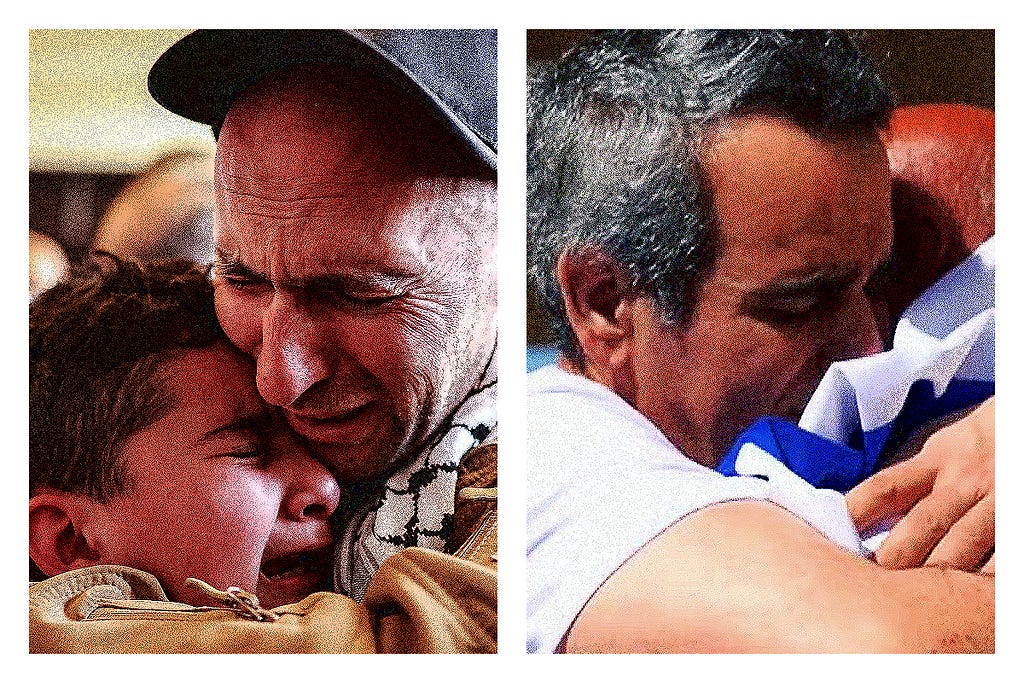
I’ve been avoiding posting on social media for days now and mostly just lurking. Reading. Getting frustrated. Tweaked.
Trying to hold onto something real in a flood of reactions, hashtags, memes, demands, judgments. I want to say the right thing.
But more often, I just want to feel something bigger than despair.
I’m glad the fighting has paused. I’m glad the hostages are home. I’m glad, for once, the skies are quieter, the nights don’t tremble so often, the ambulances slow, the walls of fear crack ever so slightly.
Yes — I’m happy about that. Deeply.
But it is not a victory lap. Not by a long shot. That kind of happiness — the happiness of a war “done,” of justice “achieved” — would be hollow here.
All I have is “better than yesterday,” and that is both something and nothing. It’s not enough. It’s not the metric of peace.
Because peace is not the absence of violence. Peace is the presence of equitable justice. Not just a truce or lull, but the flourishing of human dignity for everyone.
When the Prophet Muhammad (peace be upon him) died, Abu Bakr (the first caliph) stood before the people and said:
“Whoever among you worshipped Muhammad, then know that Muhammad is dead; but whoever worships God, know that God is Ever Living and does not die.”
The moment was not just about loss. It was a reminder: don’t idolize the messenger; worship the timeless. Don’t let your devotion be to comfort, or to figures, or to temporary outcomes. Devote yourself to what must outlive violence — to justice, to truth, to the living.
If what you worship is only “no rockets, no bombs, no tension,” then this moment may feel like peace.
But if what you seek is justice — for all people — then this moment is just a breath, not a breakthrough. A necessary pause, yes. But not a resolution.
Just because you started thinking about this situation on October 7, 2023, doesn’t mean that that’s when it started. And just because you stop thinking about this situation in October 2025 doesn’t mean that’s when it ended.
October 7 was a catastrophe. It tore open wounds, stole lives, and left forever scars in Israeli families. The trauma is real, indelible, and must be acknowledged without equivocation.
But it is a special kind of stupid that insists that the story started there. It didn’t. It didn’t start with rockets or with tunnels. It began long before — in the dispossession of homes, in the checkpoints and concrete walls, in the normalization of suffering and humiliation, in a world that has tolerated statelessness and displacement for generations.
And yes — even within that pain — Hamas has made things worse. Much worse. It has ruled with violence, silenced dissent, used its own people as leverage in a game where everyone loses. It has hijacked the cause of liberation and turned it into a death cult masquerading as resistance.
And on the other side, Israel’s right-wing government — fueled by religious zealotry and nationalism — continues to provoke, punish, and expand. It arms settlers, protects land theft, and dismisses international law with impunity. It treats vengeance as diplomacy, and dominance as destiny.
So here we are — again — standing in the middle of a ceasefire while the people who suffer most, Palestinians and Israelis, have gained almost nothing but more suffering and loss.
I dare to imagine something more.
I dare to imagine a day when Palestinian children wake up not to surveillance drones or rubble, but to breakfast and school and futures not yet stolen. A day when water flows clean and free, when roads are open, when birthright isn’t a sentence.
I dare to imagine a day when Israeli children are no longer drilled on siren responses before they learn how to write their names. A day without bomb shelters as architecture. A day where Jewish safety is no longer framed as dependent on Palestinian erasure.
I dare to imagine borders that are not prison gates, but crossings between lives — marked not by checkpoints and guns, but by cooperation, by coexistence, by trust built painstakingly over time.
I dare to imagine a justice that does not flinch: truth commissions, legal accountability, and global recognition of suffering on all sides — not to keep score, but to heal what denial has allowed to fester.
I dare to imagine classrooms that teach not just one history, but both. That honor the losses and sufferings and pains and traumas of all people. That make space for both truths, so that children grow up knowing their pain does not cancel someone else’s. That your grief doesn’t erase mine.
I dare to imagine a shared culture and a shared ‘language’ with a common grammar that is rooted in empathy, where difference is not threat, and where solidarity doesn’t mean sameness — just shared humanity.
This isn’t a utopia. This is a roadmap — fragile, slow, imperfect — but a real alternative to endless blood and blame.
So yes: I feel relief. I feel gratitude that lives are spared today. I feel love for people — Israelis, Palestinians, anyone still willing to hope in this wreckage. Anyone still showing up, still reaching across, still refusing to harden.
Because relief is not justice.
Because silence is not peace.
Dr. Martin Luther King Jr. said that “True peace is not merely the absence of tension; it is the presence of justice.”
Justice means Palestinians live in freedom, safety, and rights — not someday, not conditionally, but fully.
Justice means Israelis live without fear — not behind walls, but in a future where safety doesn’t come at the cost of someone else’s freedom.
Justice means no more children raised among rubble and caution. No more hostages or orphaned families. No more bombed hospitals, no more schools leveled, no more fear as daily routine. No more justifying one atrocity with another.
Justice means we finally admit that both peoples deserve full, free, meaningful lives — and that one people’s liberation should never demand the erasure of the other’s.
This is the work.
It’s slower than war. It’s harder than airstrikes. It’s messier than flags.
But it is the only way forward.
Because peace is not the moment when violence ends.
Peace is what you build when no one is watching.
It is what you whisper between heartbreaks.
Peace is what you fight for — with compassion, with clarity, with relentless moral focus — even when the world tells you to pick a side or stay quiet.
We’re not there yet.
But I still believe we can be.
And that belief — stubborn, exhausted, aching — is where I’ll keep standing.
I pray that others do too.